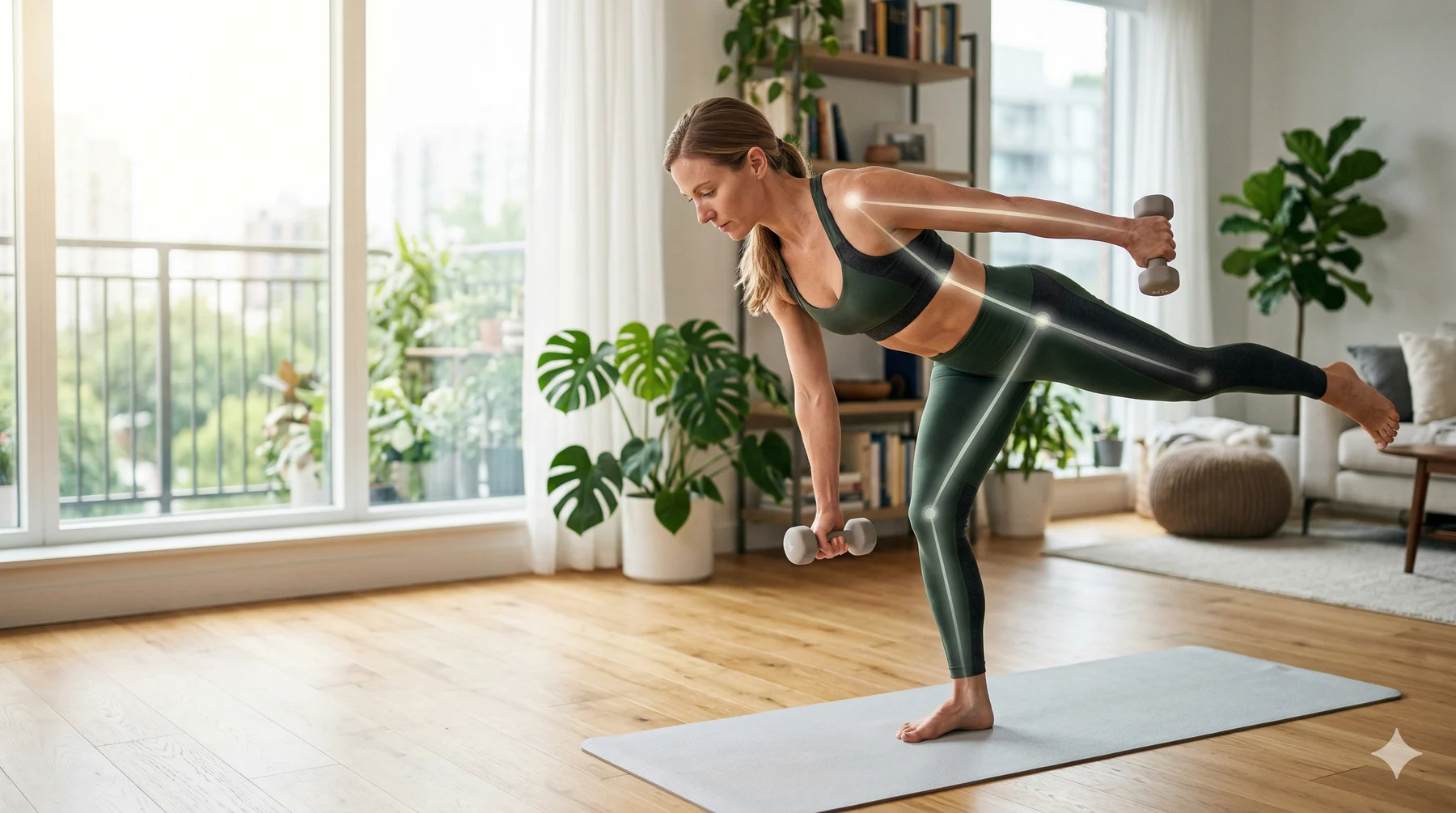
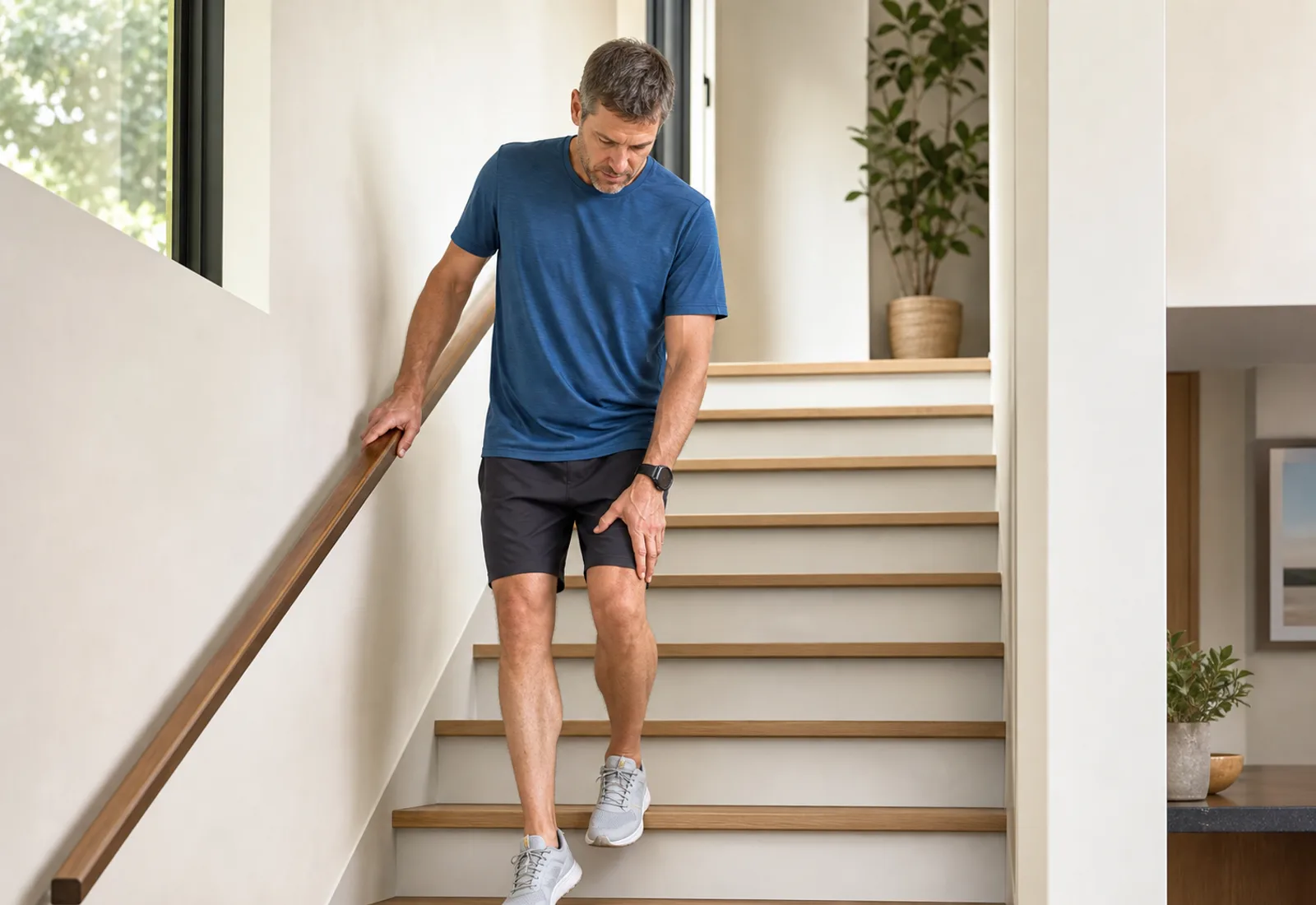
Knee pain going down stairs is a very specific pattern. Flat walking may feel fine, but the moment you start descending steps the knee becomes sharper, more guarded, or harder to trust.
People describe this in a few ways: knee pain downstairs, pain in the knee going down stairs, front of knee pain on stairs, or a knee that hurts when going downstairs but not always when going up. Those phrases are useful because they point to a real movement demand: controlled lowering.
Who this page is for
This page is for people whose knee reacts most clearly during stair descent, step-downs, downhill walking, or the lowering phase of lower-body exercises. It is especially useful if the same area also responds during knee pain when squatting, patellar tendon pain, or return-to-training weeks where loading changes quickly.
Common scenarios
Common versions include:
- the knee feels mostly normal on level ground but complains on stairs
- going down hurts more than going up
- downhill walking, squats, lunges, and stair descents stack together in the same week
- pain appears after increasing daily steps, gym work, running, or travel
- the knee feels more guarded because each step down feels unpredictable
Quick answer for knee pain downstairs
Knee pain downstairs often means the current stair demand is ahead of what the knee and lower body are tolerating comfortably right now. Descending stairs is not just "walking but lower." It asks the body to control body weight, bend the knee, manage balance, and slow the step smoothly.
That does not automatically mean the knee is damaged. It does mean the pattern deserves a closer look before you keep pushing through the same stair volume.
Why going down can feel harder than going up
Going upstairs is effortful, but going downstairs often exposes control. The knee has to accept load while the body lowers. If the front of the knee is sensitive, if the week has included more squatting or hills than usual, or if the leg is not sharing load well through the hip and ankle, stair descent can become the clearest place the pattern shows up.
This is one reason the symptom can feel confusing. You may be able to walk, cycle lightly, or do upper-body training without much issue, then feel a sharp reminder on the stairs.
What changed recently
The most useful first question is rarely “what is the perfect stair technique?” It is usually “what changed?”
Look back over the last one to two weeks:
- Did running volume, walking volume, or hill exposure increase?
- Did you restart squats, lunges, step-ups, jumping, or court sport?
- Did travel, work, sleep, or recovery make the same load harder to tolerate?
- Did you use more stairs than usual at home, work, school, or public transport?
- Did the knee already feel irritable before the stairs became obvious?
If one of those changed, the stairs may be showing the load mismatch rather than acting as the only cause.
How it connects to squats and front-of-knee pain
Stairs and squats are different tasks, but they can expose related issues. Both involve knee bend, load control, and confidence. If stairs hurt and squats also hurt, it may help to read the broader knee pain when squatting guide.
If the discomfort is very localized near the tendon below the kneecap and is tied to jumping, landing, sprinting, or heavy lower-body loading, the patellar tendon pain guide may be more relevant.
If the pain is broader around the front of the knee, especially around stair descent, it can overlap with patterns often discussed as patellofemoral pain. That label can be useful, but it still does not diagnose your exact situation from a webpage.
A calmer way to experiment
The goal is not to prove you can tolerate the hardest stair day. The goal is to find a baseline that gives clearer feedback.
For some people, that means:
- using a rail temporarily
- slowing the descent
- reducing repeated stair trips for a short period
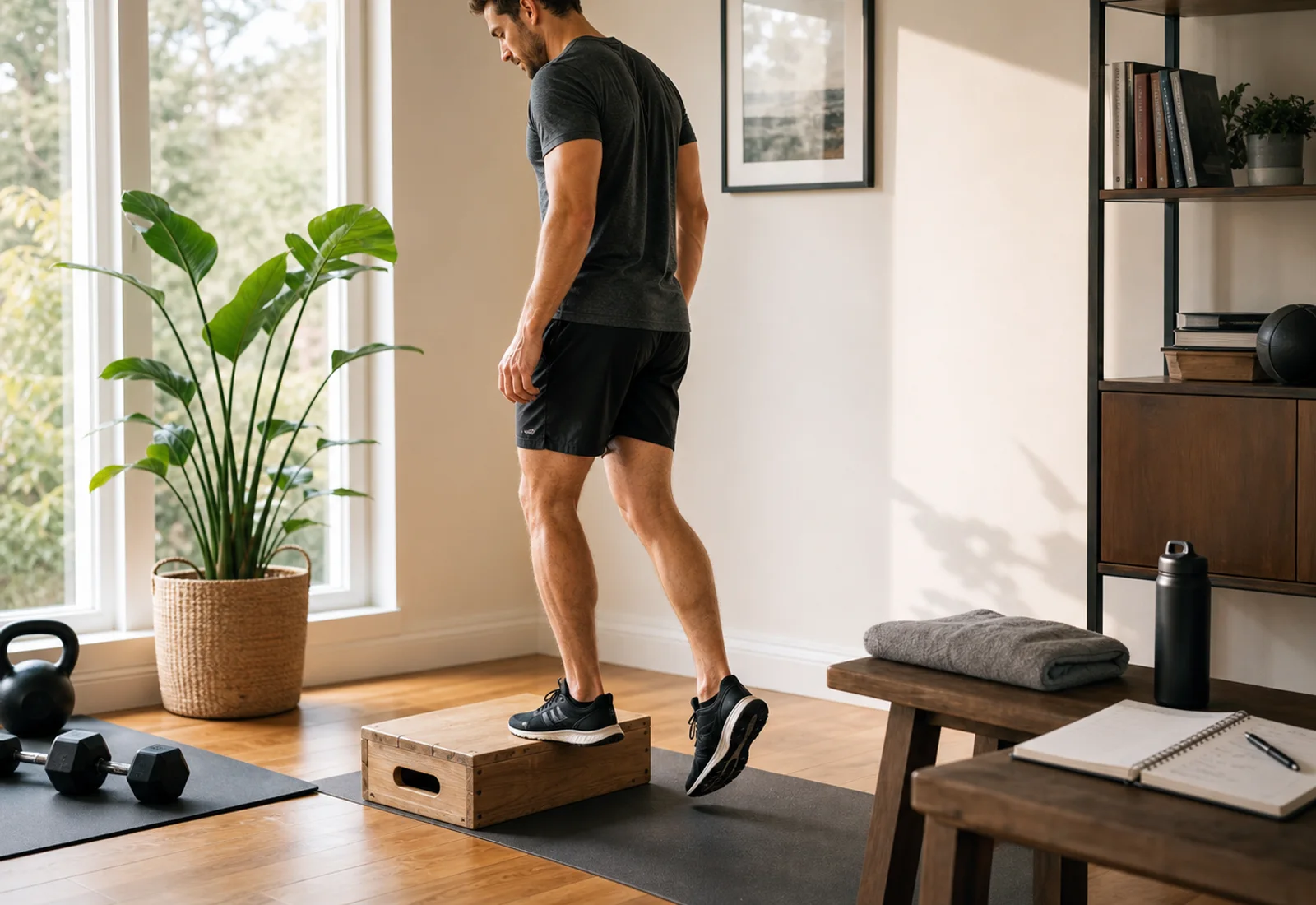
- testing a smaller step-down height before a full stair flight
- spacing squats, hills, runs, and stairs more intelligently across the week
Those changes are not a permanent identity. They are a way to reduce noise while you rebuild tolerance.
When to stop self-testing
Self-guided adjustment is not the right next step when the pattern includes trauma, rapid swelling, inability to bear weight, locking, instability, numbness, fever, severe night pain, or rapidly worsening symptoms. In those cases, the safer move is professional evaluation.
If the pattern is familiar, mild, and clearly tied to recent load, a structured assessment can help you decide what to change first. If it feels severe, strange, or unstable, do not use stair experiments as reassurance.