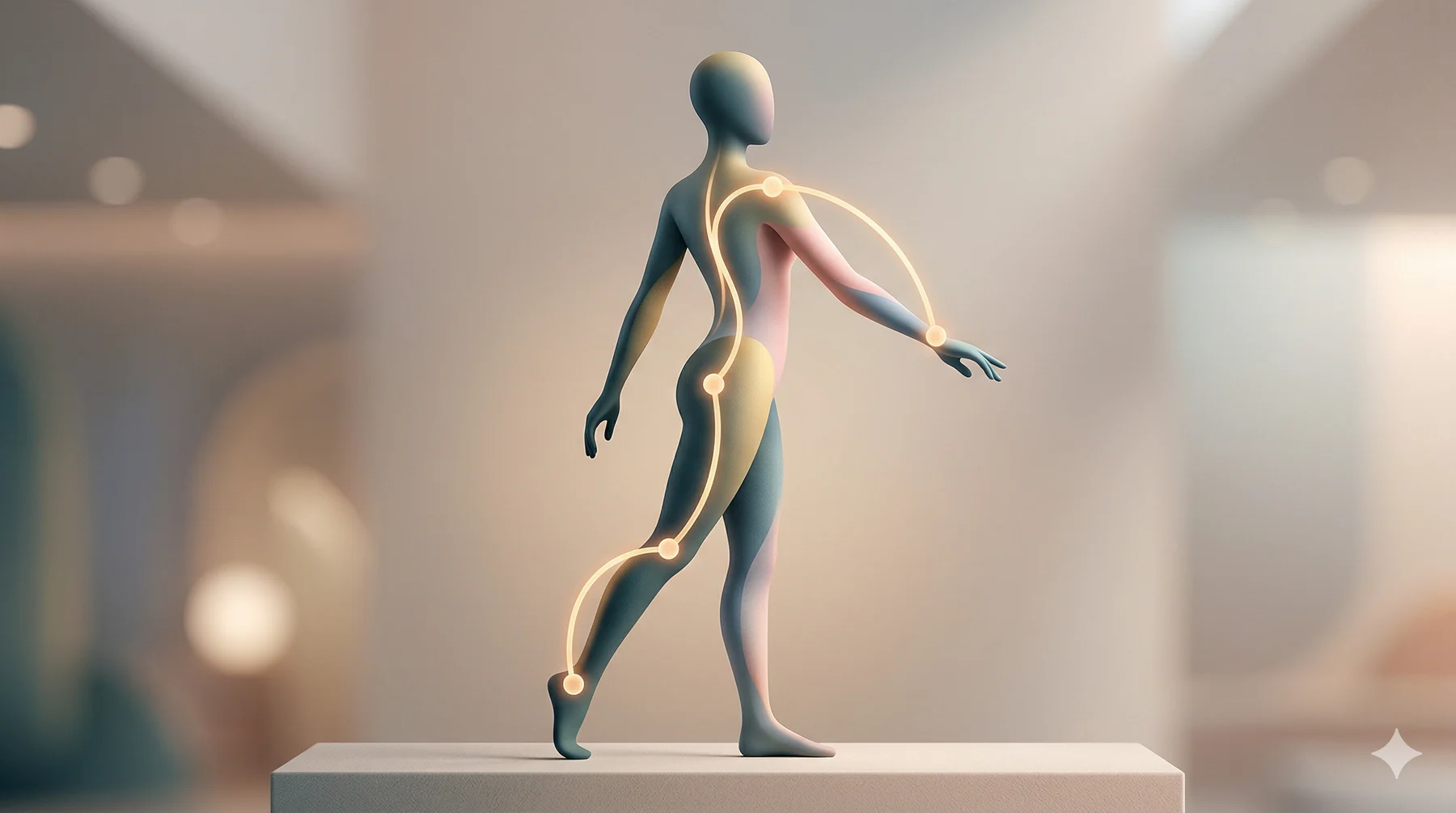

Posture is an important part of body balance, but it is not a diagnosis on its own. In most real-world cases, poor posture can be both a contributor and a symptom. It can add stress to muscles and joints when the same position or compensation gets repeated for too long. It can also change because the body is protecting a painful area, adapting to stiffness, reacting to fatigue, or trying to feel more stable.
That is why the most useful question is not simply whether posture is "good" or "bad." The more useful question is what combination of load, movement habits, strength, stiffness, and balance is shaping the way your body is organizing itself today.
Who this page is for
This page is for active adults who notice slouching, leaning, stiffness, or balance changes and want something more useful than "just sit up straight." It is especially relevant if posture seems to worsen during desk work, travel, repetitive training, recovery from a flare, or long periods of low movement variety.
Common scenarios behind the search
Common stories include:
- your shoulders round forward by the end of the workday even though you try to sit taller
- you can "fix" your posture for a minute, but it feels tiring or unnatural to hold
- you lean away from one side after back, hip, or knee pain starts
- you feel more stooped when tired, stressed, or after long sitting
- your balance feels worse when you move quickly, turn your head, or stand on one leg
- posture drills help a little, but the same pattern keeps coming back
What posture really means
Posture is simply how you organize your body in standing, sitting, walking, reaching, lifting, and everything in between. That includes static posture - how you hold yourself when you are still - and dynamic posture - how you hold yourself when you move.
That matters because posture is not just a spine issue. It reflects how your muscles, joints, eyes, inner ear, nervous system, and movement habits work together to keep you upright and steady. In other words, posture is part of body balance, not separate from it.
It is usually not one bad posture
This is where posture advice often goes off track. Many people are taught to think there is one "correct" position and that every ache is caused by drifting away from it. Reality is less rigid than that.
There is no single perfect posture that guarantees a pain-free body. Research has not shown that one exact sitting or standing shape prevents low back pain in every person. A slouched position is not automatically harmful. A very upright position is not automatically better. What usually matters more is how long you stay there, how much strength and flexibility you have to support it, and whether your body has enough movement options across the day.
That is why posture correction on its own often feels disappointing. The pattern is usually broader than that.
Can poor posture cause other problems?
Yes, it can contribute. But it usually contributes as part of a larger pattern rather than acting as the single root cause.
1. Long uninterrupted positions
If you sit, stand, drive, or look down at a screen for long periods, the body can become stiff, tired, and less tolerant of load. Over time, one repeated shape can create neck tension, upper-back fatigue, low-back discomfort, or reduced hip and thoracic movement. The issue is often not the position itself but the lack of variation.
2. Reduced movement variety
A body that repeats the same pattern all day becomes very good at that one pattern and less comfortable in others. If your work, training, or recovery has narrowed your movement "diet," posture can start to feel stuck. This is common in desk work, frequent travel, repetitive lifting, cycling, gaming, and sport-specific training blocks.
3. Strength and endurance gaps
Sometimes posture falls apart late in the day not because you forgot to sit up straight, but because the system supporting you is getting tired. Weak or under-trained trunk, hip, upper-back, and neck muscles can make it harder to tolerate long sitting, standing, carrying, or overhead work. In that case, posture is partly a load-capacity issue.
4. Joint mobility limits
If the upper back is stiff, the hips do not extend well, the ankles are restricted, or one shoulder lacks range, the body will usually find another path. That compensation becomes visible as a posture pattern. What looks like a posture problem may really be a mobility workaround.
5. Habit and environment
Posture also responds to what your day asks from you. Laptop work, poor screen height, low chairs, one-sided bag carrying, certain shoes, stress, and rushed breathing patterns can all shift how you hold yourself. That does not mean they guarantee pain. It means they can keep nudging the same pattern.
Can poor posture be a symptom of something else?
Yes. This is the part that often gets missed.
1. Pain-protection patterns
Pain often changes posture before you even think about it. A sore low back may make you stand bent or crooked. A painful shoulder may make you round forward or rotate away. A hip flare may shift your weight to the other side. In these cases, the posture change is the body protecting the sensitive area.
2. Fatigue or deconditioning
When posture collapses later in the day, the question may be less about alignment and more about endurance. The body often loses shape when tired. That is especially common after illness, injury, layoffs from training, poor sleep, or long periods of inactivity.
3. Balance and sensory problems
Body balance depends on more than muscles. If your inner ear, vision, joints, muscles, or nerves are not giving clean information, posture may change so you can feel more stable. People with balance issues sometimes widen their stance, walk more cautiously, lean, or avoid turning quickly.
4. Structural or degenerative changes
Arthritis, spinal degeneration, hyperkyphosis, scoliosis, or longstanding mobility loss can change how the body stacks itself. Here again, posture is not just a choice. It can reflect what the joints and tissues currently allow.
5. Neurological conditions
Less commonly, posture changes may be shaped by neurological conditions that affect movement, coordination, or balance. This is one reason a new stooped posture, increasing falls, shuffling gait, tremor, numbness, or clear weakness should not be written off as "just posture."
Why "perfect posture" is usually the wrong target
Trying to hold a rigid, ideal posture all day often creates new tension without solving the underlying issue. Most people do better with better options, not a single frozen position.
A useful posture goal looks more like this:
- you can move in and out of positions without fear
- you do not stay in one posture too long
- your joints have enough mobility to share the work
- your muscles have enough strength and endurance to support the task
- your balance system feels stable enough that you do not need to guard every movement
The body usually responds better to variation than perfection.
What to assess first instead of only blaming posture
Before you label posture as the problem, ask:
- What task or position brings symptoms on most clearly?
- What changed recently in workload, training, sleep, stress, or recovery?
- Does the posture change happen immediately, or only after fatigue builds?
- Is the posture easy to change for a moment, or does pain or stiffness stop you?
- Do you notice dizziness, blurred vision, frequent stumbles, or fear of falling?
- Which areas feel stiff, and which feel weak or overworked?
- Does the pattern make more sense when you look above and below the sore area?
That wider view is often more useful than staring at a mirror and trying to "stand better."
What to modify first this week
If your posture seems to be feeding discomfort, start with the smallest change you can actually repeat:
- Break up long positions. Stand up, walk, stretch, or change setup before stiffness gets loud.
- Train support, not just appearance. Build strength and endurance in the trunk, hips, upper back, and legs.
- Restore movement where you keep compensating. Upper-back, hip, ankle, and shoulder mobility often matter more than posture cues alone.
- Make the environment easier. Raise the screen, improve chair support, bring work closer, vary desk positions, or change the task order.
- Add balance work if stability feels off. Standing on one leg, heel-to-toe walking, stepping drills, or guided balance work can be useful when tolerated.
- Match the plan to the real week. A routine that fits normal life beats a perfect plan you never repeat.
This is the same reason kinetic-chain thinking matters: the visible posture is often shaped by what nearby areas are doing, not just the spot that looks "off."
What not to do this week
Do not spend the week aggressively bracing, squeezing your shoulder blades together all day, or chasing perfect symmetry in the mirror. That usually creates more tension and tells you very little about why the pattern keeps returning.
Also avoid jumping straight into a huge corrective routine. One or two changes you can actually repeat across a normal week usually teach you more than a full "posture reset" you abandon after three days.
When professional evaluation comes first
Do not treat posture as a do-it-yourself problem first if you notice:
- a sudden new stooped posture, leaning, or inability to stand upright
- repeated falls, strong dizziness, vertigo, or blurred vision
- weakness, numbness, tingling, or loss of coordination
- back pain after a fall or other injury
- new bowel or bladder problems
- fever, unexplained weight loss, or pain that is severe and not improving
- rapidly worsening symptoms or changes that feel unusual for you
In those situations, posture may be reflecting a bigger issue that deserves proper evaluation.
The bigger picture for JointReset readers
At JointReset, posture makes the most sense when it is treated as part of a whole-body pattern. Work habits, repetition, alignment, recent training changes, joint stiffness, and movement confidence often overlap. That is why a body-specific plan is usually more useful than generic cues to "sit up straight" or "pull your shoulders back."
If the same posture pattern keeps returning, the next step is rarely more mirror checking. It is usually better assessment:
- what the day keeps asking from your body
- what has changed recently
- which joints are not sharing load well
- which muscles are underprepared for the task
- whether balance or sensory issues are also part of the picture
That is also why readers often pair this topic with how work habits affect elbow and shoulder pain and the broader method page.
Bottom line
Poor posture can be a cause, a symptom, or both. It can contribute to discomfort when the same position or compensation keeps getting repeated, but it can also reflect pain, stiffness, weakness, balance problems, or an underlying condition. The goal is not to force one perfect posture. The goal is to understand the pattern well enough to improve how your body balances, moves, and tolerates load.