
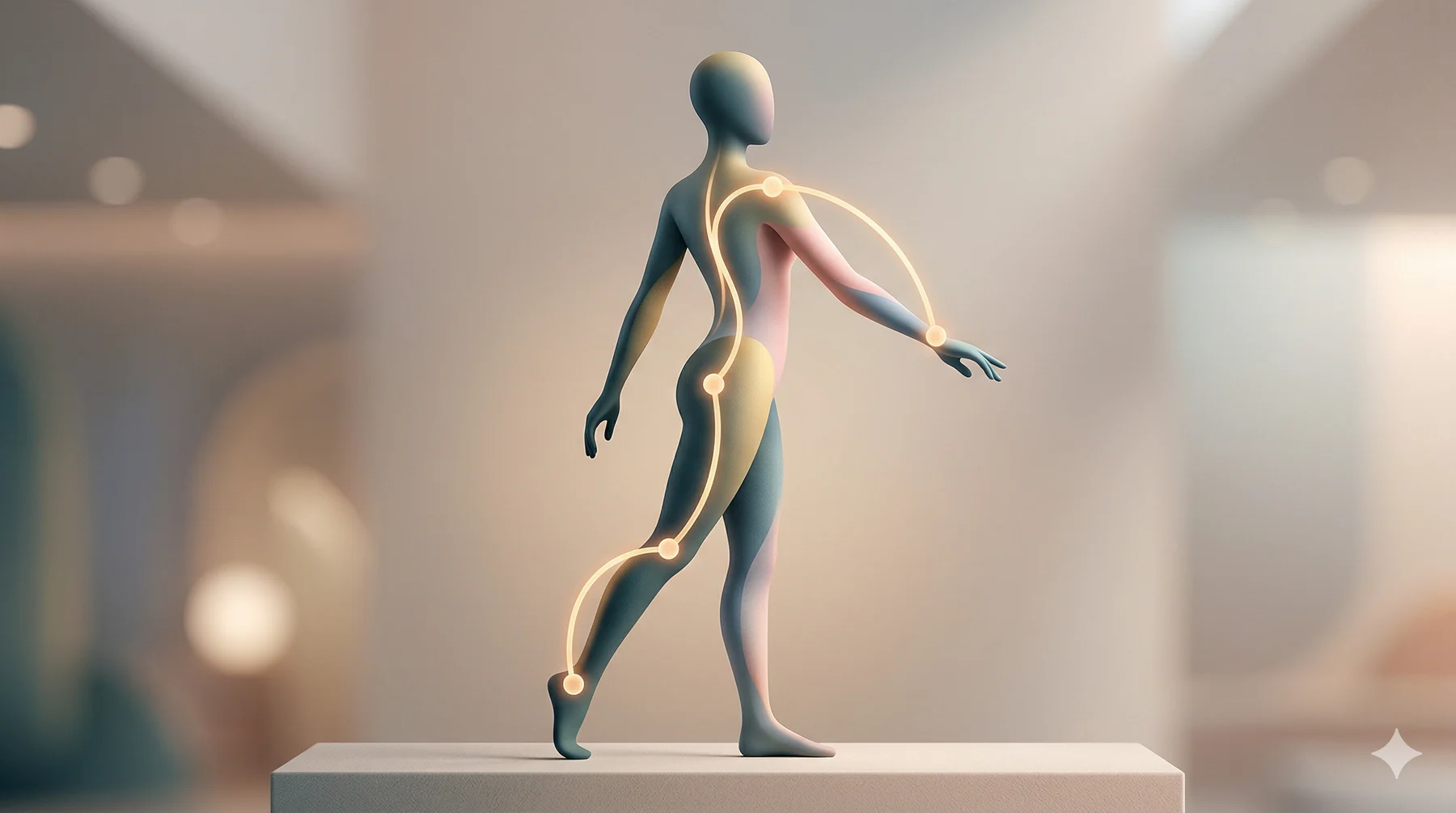
Kinetic-chain language can sound more complicated than it really is. In plain terms, the kinetic chain is the way your body links joints, muscles, and timing together during a real task. When one part is overloaded, another part may be contributing to how that load is being handled.
That does not mean every pain problem has a hidden root cause somewhere else. It means the painful area may be part of a bigger task pattern worth understanding.
Who this page is for
This page is for people who keep hearing whole-body language but are not sure whether it actually helps. It is especially useful if your pain seems to show up during a repeat task like shoulder pain reaching overhead, tennis elbow from computer work, or knee pain when squatting.
Common scenarios behind the search
Typical examples include:
- a knee that feels like the only problem until ankle or hip limitations become obvious
- an elbow flare that makes more sense once shoulder fatigue and desk setup are considered
- a shoulder that becomes painful overhead after long periods of low movement variety
- a wrist or forearm pattern that only appears at the end of a full upper-limb workload day
What is the kinetic chain?
The kinetic chain is a practical way to say that movement is shared. A squat uses the ankle, knee, hip, trunk, and balance strategy. Reaching overhead uses the shoulder, shoulder blade, rib cage, trunk, and sometimes the legs if the task is standing. Typing or gripping can involve the wrist, elbow, shoulder, neck position, desk height, and how long the task continues.
The point is not to make every problem whole-body by default. The point is to ask whether the painful joint is doing more work because another part of the task is not contributing well.
Open versus closed kinetic chain, in plain language
People often find this page while trying to understand open-chain and closed-chain exercise language. The simplest distinction is whether the end of the limb is fixed or free:
- closed-chain examples: squat, step-up, wall push-up, plank, or a supported crawling pattern
- open-chain examples: seated knee extension, straight-leg raise, arm raise, or wrist curl
Neither category is automatically better. A closed-chain task can feel more task-like because the hand or foot interacts with the ground or a surface. An open-chain task can be useful when you need a simpler, more isolated dose. The right choice depends on the current irritability, the task you want back, and what response you can repeat.
One painful area does not always tell the full story
If your knee hurts when you squat, it is tempting to think the answer must live only in the knee. Sometimes it does. But the pattern can also be shaped by ankle stiffness, hip control, trunk position, training volume, or fear of loading deeply.
The same idea applies higher up the body:
- elbow pain can build around shoulder position and repeated desk posture
- shoulder pain can be influenced by thoracic motion, workload, and movement confidence
- wrist pain can reflect how the whole upper limb is being used during typing or gripping tasks
Kinetic-chain thinking simply gives you permission to look wider than the spot that hurts.
How this relates to regional interdependence
In rehab language, a related idea is regional interdependence: the possibility that one body region can influence symptoms or function in another. For a person trying to make sense of recurring pain, that idea is useful only when it stays practical.
Good questions include:
- does the symptom show up during a specific task?
- does one nearby region seem to change how that task feels?
- did workload, position, or repetition change recently?
- can one small adjustment make the next attempt clearer?
If the answer is no, the local area may still be the main starting point. If the answer is yes, the chain view can make the plan sharper.
What changed recently
Chain thinking becomes much more useful when you pair it with recent changes. A small ankle issue matters more if running volume also increased. Desk posture matters more if mouse time doubled. The wider view is not about finding an abstract root cause. It is about noticing which linked factors changed before the flare.
This does not mean everything is connected to everything
One risk with whole-body language is that it becomes so broad that it stops being useful. Good kinetic-chain thinking is still focused. It asks:
- what nearby or linked areas are most likely to matter here?
- what tasks trigger the problem?
- which adjustments are actually testable?
That is very different from turning recovery into an endless hunt for hidden causes.
What to modify first
If you want to apply chain thinking this week, start by changing the smallest linked variable that seems plausible:
- improve the contribution of one nearby area
- reduce one task-specific aggravator
- make the main movement easier to repeat
- pair the change with a realistic return goal
That same logic is built into the JointReset assessment and method page, where the goal is to make the first plan more focused, not more complicated.
Why this matters for recurring pain
Recurring pain often survives when the plan only treats the obvious surface trigger. If the broader pattern stays the same, relief may be temporary. That does not mean every problem is complicated. It means a better starting point usually comes from looking at the task, the context, and the chain together.
What a practical chain-based assessment looks like
A useful assessment might look at:
- the main painful task
- movement quality around that task
- how much load has changed recently
- whether another area is stiff, underused, or doing too much
- what the person wants to return to
This is where chain thinking becomes practical. It helps make the plan smaller and sharper, not bigger and blurrier.
What not to do this week
Do not use kinetic-chain language as a reason to add ten new drills at once. If the wider view helps, it should reduce noise. If it keeps expanding the routine, it is probably not helping yet.
Practical takeaway
If pain keeps returning, do not stop at the label. Look at the task, the recent workload, and the nearby areas that might be changing how the load is shared. Kinetic-chain thinking is not about making recovery abstract. It is about making the next step more accurate.